

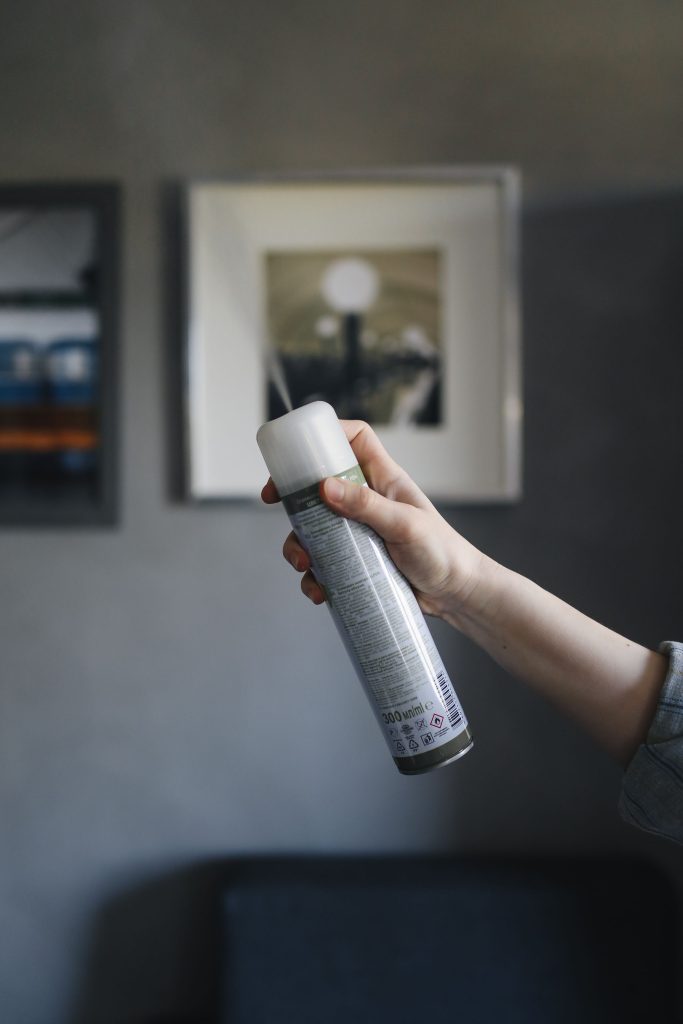
What masking actually does
Most air fresheners work by adding a scent that’s stronger than the one you’re trying to hide. For a while, your nose is busy with the new smell and the old one takes a back seat. That’s masking, and it’s the reason a room can smell lovely when you walk in and then something else creeps back through within the hour.
There’s also a quirk of the nose that makes masking tricky. Your sense of smell adapts to whatever you’re exposed to, so you stop noticing it after a while. The room still smells of whatever is causing the problem, but you’ve stopped registering it. Guests, neighbours and the people you live with usually still do.
Why the mix can make things worse
Layering a heavy fragrance over a stale smell can create a third smell that’s harder to pin down. Smoke with pine, or damp with vanilla, often ends up smelling like a sickly combination. Some people also find strong fragrances irritating, especially in small rooms, so it’s not always a neutral choice.
Plug-in fresheners and scented candles keep adding to the air for as long as they run. That’s fine if you want a pleasant scent, but it doesn’t deal with whatever is producing the smell in the first place.
What a neutraliser does differently
Odour neutralisers take a different route. Some of them use ring-shaped sugar molecules called cyclodextrins, which have a hollow centre that traps small, volatile odour molecules. Others rely on reactive ingredients that change the odour molecules into something that doesn’t register as a smell. The goal in both cases is to reduce what reaches your nose, not to add a louder scent on top.
D-ODR is built on that principle. The brand describes it as “NO MORE MASKING”, using bio-identical terpenes to remove the smells you don’t want and then leaving one of five flavours behind. You can read more about how the terpenes are chosen on the science pages of the site, and the flavour you pick is simply the scent you’re left with, not the thing doing the removing.
A simple test you can try
Spray a small amount of air freshener into a room that smells of cooking, then leave the door shut for an hour. Come back and smell the room again. If the original smell is still there underneath, you’ve masked it. If it’s gone, something has removed the molecules rather than covering them.
Of course, the best fix is still to find the source. Clean the bin, wash the bedding, dry the damp corner and open a window. A neutraliser helps most once the source has been dealt with, because you’re treating what remains in the fabric and the air.
Where to start
- Work out where the smell lives: fabric, carpet, bin, drain or wall.
- Clean that thing properly and let it dry.
- Ventilate the room for a while, even in cold weather.
- Then use a neutraliser for the smell that’s left, rather than piling more fragrance on top.
If you’re tired of the cycle of spritzing and smelling again, the difference is worth testing for yourself. A smell that’s been removed doesn’t come back in the same way a masked one does.